
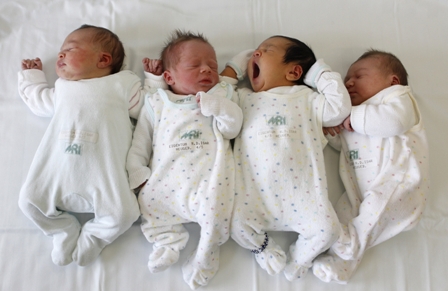
Welcome to 2018: Over 20,000 babies will be born today, UNICEF says
-
Urges nations around the world to ensure newborns survive first days of life
Nigeria will witness the birth of over 20,000 newborns today, January 1, 2018, as people of the country join the rest of the world to welcome the New Year with festivities, the United Nations Children’s fund (UNICEF), has said.
According to a statement made available to Nigeria Health Online by the Nigerian office of the organization on Sunday December 31, 2017, the country will see a total of 20,210 babies, which will be nearly one-third of what will delivered same day in India (69,070).
The figure is also less than half of babies that will be born in China (44,760) It is however over 400 percent of those expected in the US (11280) on the first day of the year.
UNICEF revealed that Kiribati’s Christmas Island, a small island in the Pacific, will most likely welcome 2018’s first baby; and the United States, its last.
The organization gave estimated number of children expected to be born in nine countries of the world on the first day of the year as follows: India, 69,070; China, 44,760; Nigeria, 20,210; Pakistan, 14,910; Indonesia, 13,370.
Others are United States of America, 11,280; the Democratic Republic of Congo, 9,400; Ethiopia, 9,020; and Bangladesh, 8,370.
While many of the babies will survive, some will not make it past their first day, UNICEF predicted.
“In 2016, an estimated 2,600 children died every day of the year, on the day they were born. For almost 2 million newborns, their first week was also their last. In all, 2.6 million children died before the end of their first month.
“Among those children, more than 80 per cent of all newborn deaths are due to preventable and treatable causes such as premature birth, complications during delivery, and infections like sepsis and pneumonia,” the agency stated.
It challenged nations around the world to make sure more newborns survive their first days of life.
Acting Representative, UNICEF Nigeria, Terry Durnnian, said in the release that in this New Year, “UNICEF’s global resolution is to help give every child more than an hour, more than a day, more than a month – more than survival.”
She noted that the world was entering an era when all the world’s newborns should have the opportunity to see the 22nd century, but that unfortunately, nearly half of the children born this year likely would not.
According to her, a child born in Sweden in January 2018 is most likely to live to 2100, while a child from Nigeria would be unlikely to live beyond year 2072.
She called on government and partners to join the fight to save the lives of millions of children by providing proven, low-cost solutions.
The release furthered: “Over the past two decades, the world has seen unprecedented progress in child survival, halving the number of children worldwide who die before their fifth birthday to 5.6 million in 2016. But despite these advances, there has been slower progress for newborns. Babies dying in the first month account for 46 per cent of all deaths among children under five.
“Next month, UNICEF will launch Every Child Alive, a global campaign to demand and deliver affordable, quality health care solutions for every mother and newborn. These include a steady supply of clean water and electricity at health facilities, the presence of a skilled health attendant during birth, disinfecting the umbilical cord, breastfeeding within the first hour after birth, and skin-to-skin contact between the mother and child.”




0 Comments
No Comments Yet!
You can be first to comment this post!