
Revealed! Doctors still treat malaria without test
-
USAID raises alarm
-
Chloroquine still being produced and prescribed in the country
-
Nation remains too endemic despite huge spending on control.
-
We have a long way to go, says USAID Country Director
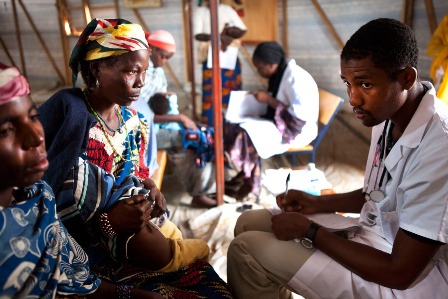
A doctor attends to a patient. A test is required to confirm malaria
The United States government, Monday, accused medical practitioners in the country of treating malaria without conducting required test, contrary to the nation’s now malaria policy.
The US, through the United States Agency for International Development, USAID, also condemned production of chloroquine in the country for the treatment of malaria.
USAID Country Director Michael Harvey stated these at the launch of Nigeria Malaria Indicator Survey report in Abuja.
Harvey said despite millions of dollars spent on the disease in the country, the nation had remained too endemic with the condition, even on the continent where other smaller nations had contained it.
Harvey said at the launch of the survey: “What is striking is that there continues to be imported nets, and we do yet have an industry in Nigeria that is producing them at a cost Nigerians can afford. What is very clear from the report however is that there are some immediate to-do in our action list, first people are testing, to see if a fever is malaria.
“And, this is something that should be doable since affordable test kits are readily available either through the public sector or private sector at an affordable cost. Too many medical professionals are still treating without testing and this is easy to fix, but the men and women need to be taught about changing that culture in the Nigerian medical professional.
“Second, we are not treating malaria proper. I am surprise to find out when you travel around Nigeria Chloroquine is ready available and too readily prescribed as a treatment for malaria. Worst, this is actually a major public policy that we have to get on top of. We are still producing Chloroquine in Nigeria, a drug that has no beneficial use either for malaria or any other use. We have some challenges, and for those who are in the front lines of providing health care to the poorest, and it is always important to bear the greatest burden. We must get on top of these short comings.”
He added: “We have a long way to go. So, please support your health workers, support your communities, health volunteers, get them the tools they need. Let’s get on top of it. We have seen across Africa, tremendous decline in Malaria across the continent. We are behind, but it is doable, that malaria is eliminable and that is one of the most urgent messages. We have a lot of work to do and let’s do it.”
Launching the report, Minister of Health, Prof. Isaac Adewole, said: “No other disease has affected Nigeria like malaria, given that malaria is responsible for 11 per cent for maternal mortality, responsible for 25 per cent of infant mortality and 35 per cent of under-five mortality.
“And it is the single most important reason why any Nigerians visit a health facility. 60-70 per cent consultation and hospitals visits are due to malaria, and therefore this is one major problem we must face. And, when we invest in this war, the savings would be huge.
Adewole informed that the country loses about N132 billion to the disease annually, adding that the condition remained a major public health concern.
The report aims at measuring progress on malaria elimination implementation efforts with the view to ensuring that by 2020, no child or adult dies from the ailment or its related conditions.



0 Comments
No Comments Yet!
You can be first to comment this post!