

-
Calls for gender-sensitive policies
-
Says women are more likely to be prescribed narcotics and anti-anxiety medication
-
Advocates urgent health-care access for drugs-dependent women
Experts have called for gender-sensitive policies and programmes, better health-care access for drug-dependent women and more funding to prevent and treat drug abuse among women.
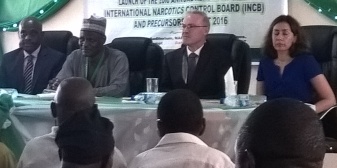
The clarion call was made earlier today during the launch of the 2016 annual report of the international narcotics control board (INCB) and precursor report 2016 at the office of National Agency for Food and Drugs Administration and Control, (NAFDAC).
“At a time when countries are reporting a disproportionate increase in drug overdoses among the Vienna-based INCB in its Annual Report for 2016 is calling on governments to do more to take women into account in their drug policies and programmes,” a statement by INCB.
INCB is however, worried and in its report wants government to give priority to providing health-care access for drugs-dependent women and calls for more funding and coordination to prevent and treat drug abuse among women.
According to INCB President, Werner Sipp, “We want to change perception and remind people, particularly policymakers, of the importance of protecting the right of women who use drugs or who have committed drug-related offences and the rights of their families,” he said.
The report further stated that women and girls comprise one third of global drug users, with levels of drugs use higher among women in high-income countries.
“However, just one fifth of treatment recipients are women, as significant systemic, structural, social. Cultural and personal barriers affect women’s ability to access substance abuse treatment.
“Compared to men, women are more likely to be prescribed narcotics and anti-anxiety medication, and are consequently more likely to abuse such medication. For example, Germany and Serbia have reported that fatal overdoses from prescription drugs are more frequent among women. Additionally, countries such as the United Kingdom of Great Britain and Northern Ireland have larger increases in overdoses, of all substances, among women than among men,” the report disclosed.
In its recommendations, INCB further condemns the extrajudicial targeting of people suspected of illicit drug-related activity; calls on states to abolish the death penalty for drug-related offences; encourage states to consider alternative to imprisonment for minor drug-related offences and finally reaffirms that legalizing cannabis for non-medical use is incompatible with international legal obligation.
The acting director, NAFDAC, Mrs. Yetunde Oni, in her welcome address said the narcotic drugs, psychotropic substances and precursors chemicals are controlled within the framework of the three international drug control conventions and are scheduled based on medical utility and potential for abuse.
She further said: “The international drug control treaties are interpreted to mean improve access to controlled medicines to enable countries meet their drug needs. It simply expects member states to ensure effective and efficient regulatory control,” while enumerating some of the NAFDAC achievements in drug control which include: pre export notification( PEN)online system for monitoring international trade in precursor chemical and also to strengthen the legitimacy of transaction of proposed imports.
Their achievements further includes, national qualification of narcotic drugs and estimation of psychotropic substances and precursors in Nigeria which will help them to come up with a more accurate national estimate of the country’s requirements of narcotics, psychotropic substances and precursors; inter-agency cooperation, e-clearance platform, increase frequency of inspection of warehouses, decentralization of the distribution of warehouses, strengthening of regulation capacity of officers, drug demand reduction activities among others.
According to Ms. Harsheth Virk, Project officer, United Nations Office on Drugs and Crime, UNODC, Nigeria, in addition to its work monitoring and promoting implementation of the three international drugs control treaties, INCB is assisting government in addressing the illicit manufacturing, trafficking and abuse of drugs and preventing their diversion and abuse, while ensuring availability of controlled medicines.
