
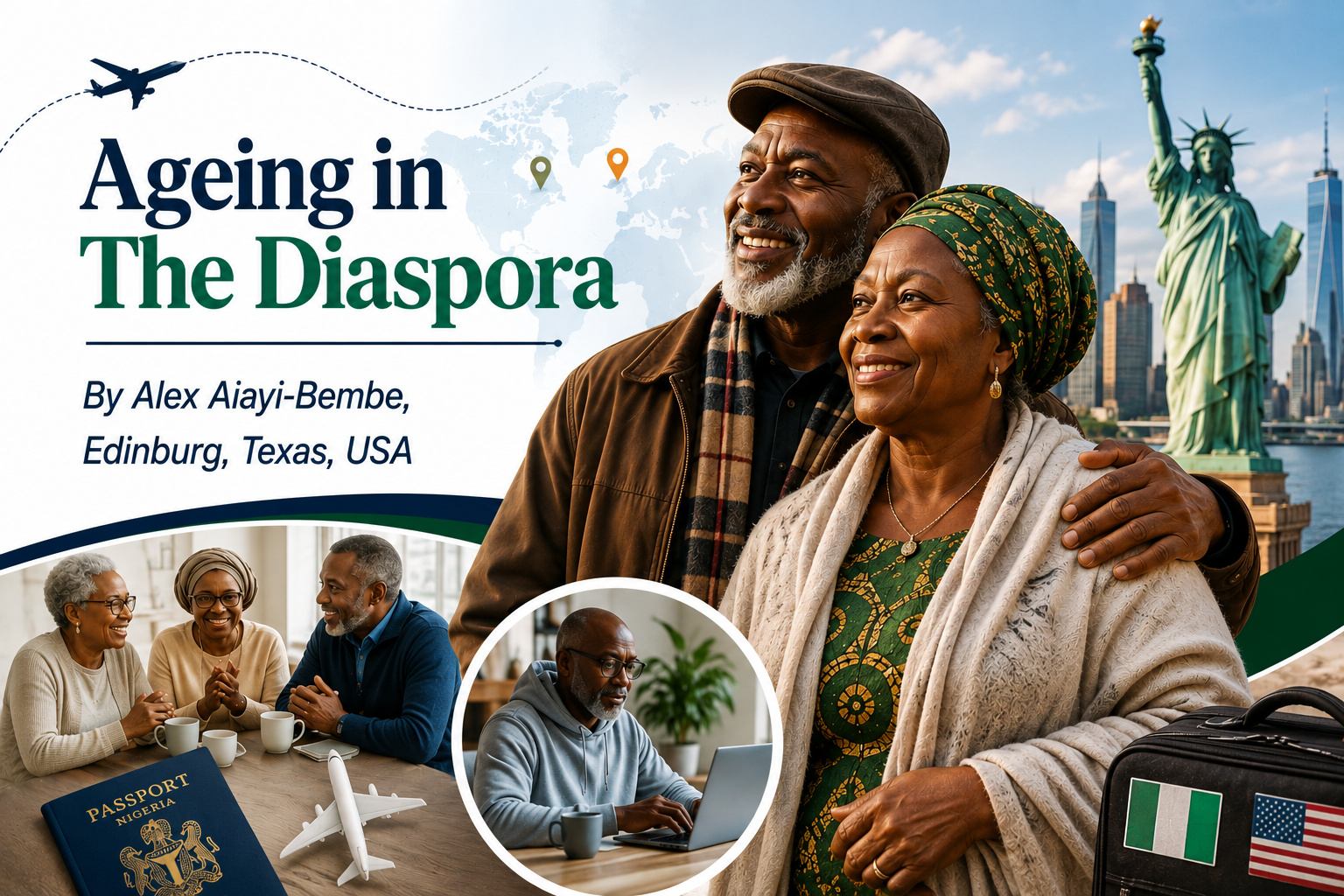

As Nigerians grow older in the diaspora, their experiences can differ significantly from those of their counterparts in Nigeria. The differences become particularly evident in four important areas: family support, access to healthcare, loneliness and long-term care.
For many Nigerians who spend most of their working lives abroad, retirement can bring a new set of challenges that may not have been anticipated during their active years. The support systems they once took for granted may no longer be readily available, while healthcare and long-term care increasingly become matters of financial planning and personal responsibility.
Family Support
Family support for older Nigerians in the diaspora is often more limited than it would be in Nigeria. This is largely systemic because, from the moment many immigrants settle in countries such as the United States, traditional family support structures gradually begin to weaken.
Even when three or four siblings or cousins migrate to the US, the likelihood of all of them remaining in the same city, town or even state is relatively low. While relatives may initially settle close to one another, career opportunities, education, personal interests and family commitments eventually take people in different directions in search of better prospects.
Over time, each person establishes a family, develops a distinct lifestyle and builds separate social networks. Extended family members may therefore come together mainly on special occasions such as birthdays, weddings, naming ceremonies and funerals.
Some families are fortunate enough to bring grandparents—especially mothers—to assist with childcare, a practice popularly known as omugwo. However, as these grandparents grow older, many become homesick and choose to return to Nigeria, where they can reconnect with extended family and familiar surroundings.
This can leave their children, who are themselves approaching retirement and grandparenthood, to navigate the later stages of life with less family support than they may have expected.
In Nigeria, it is common to call upon aunts, cousins, stepsiblings or other relatives for assistance with household responsibilities and caregiving. Such support is far less common in the diaspora. The high cost of living also means that many people remain focused on work and financial obligations, leaving little time for extended-family caregiving.
Healthcare Access
Healthcare access in the United States is also largely system-driven. During their working years, many people obtain healthcare through employer-sponsored insurance, while retirement typically brings eligibility for Medicare, often alongside Social Security benefits.
However, Medicare does not eliminate every healthcare challenge.

Retirees still need financial resources to cover premiums, deductibles, co-payments and other out-of-pocket expenses. This becomes particularly important for people managing chronic conditions such as diabetes, hypertension, arthritis or heart disease, which require ongoing medication, regular medical appointments and continuous monitoring.
For wealthier retirees, healthcare access may be less problematic. For many middle-income and especially lower-income retirees, however, obtaining and maintaining adequate healthcare can remain a significant challenge.
The transition from employment-based healthcare to retirement healthcare therefore requires careful preparation. Ageing does not necessarily reduce healthcare needs; in many cases, it increases them.
Long-Term Care
Long-term care presents another important challenge.
Those with substantial financial resources may be able to remain in their homes while paying for services such as caregivers, drivers, housekeepers, cooks or personal assistants. They may also have family members who visit regularly and provide additional support.
This arrangement is relatively uncommon among Nigerian immigrants. More often, financially comfortable retirees may choose to return to Nigeria, where they can live among relatives and receive care at a lower cost because of the favourable exchange rate between the dollar and the naira.
For others, however, returning to Nigeria may not be an option.
Some may eventually require structured support through assisted-living facilities, nursing homes or specialised residential-care programmes designed for older people with greater healthcare and daily-living needs.
The question, therefore, is not simply where one will retire, but also who will provide care when independent living becomes difficult.
Loneliness
Loneliness is a real and growing concern in the United States, even before retirement.
Many Nigerians rely primarily on churches, mosques and cultural organisations for social interaction. Those who are not actively engaged in these settings may experience significant social isolation.
Furthermore, many Nigerians do not participate regularly in recreational clubs, community centres, volunteer activities or hobby groups that could help expand their social circles.
There is also the culture of constant work.
Although a standard workweek is 40 hours, many Nigerians routinely work 60 to 80 hours. This is often driven by the need to pay bills, acquire property in Nigeria, support educational pursuits and provide financial assistance to parents and extended family members.
While these sacrifices may contribute to financial stability, they can also come at a social cost.
Many immigrants spend decades concentrating on work and family responsibilities while postponing leisure activities such as travel, vacations and tourism. In the process, opportunities to build meaningful social experiences and relationships outside work may be lost.
Retirement can therefore become a particularly lonely period for some Nigerians in the diaspora, especially when children have moved away and professional careers have ended.
Preparing for the Years Ahead
Ageing in the diaspora presents challenges that can differ considerably from those encountered in Nigeria.
Reduced family support, the complexity of healthcare systems, concerns about long-term care and the risk of loneliness all point to the need for careful retirement planning.
Financial preparation is important, but it is not enough.
Nigerians living abroad also need to think about where they want to live, who will support them if they become less independent, how they will maintain meaningful social connections and whether they intend to remain abroad or eventually return to Nigeria.
Growing older should not be treated as an event that begins at retirement. It is a process that requires preparation long before retirement arrives.
For Nigerians in the diaspora, planning early may make the difference between simply surviving retirement and enjoying it.
In my next article, I will explore practical steps Nigerians in the diaspora can take to make their retirement years more comfortable, manageable, fulfilling and enjoyable—whether they choose to remain abroad or return to Nigeria to spend their twilight years.

Ageing in the Diaspora by Alex Aiayi-Bembe is a regular weekly column under our Healthy Ageing Project, a collaborative platform on healthy ageing and longevity, with Healhtimes Communications Nigeria Limited serving as the interim administrative host
