
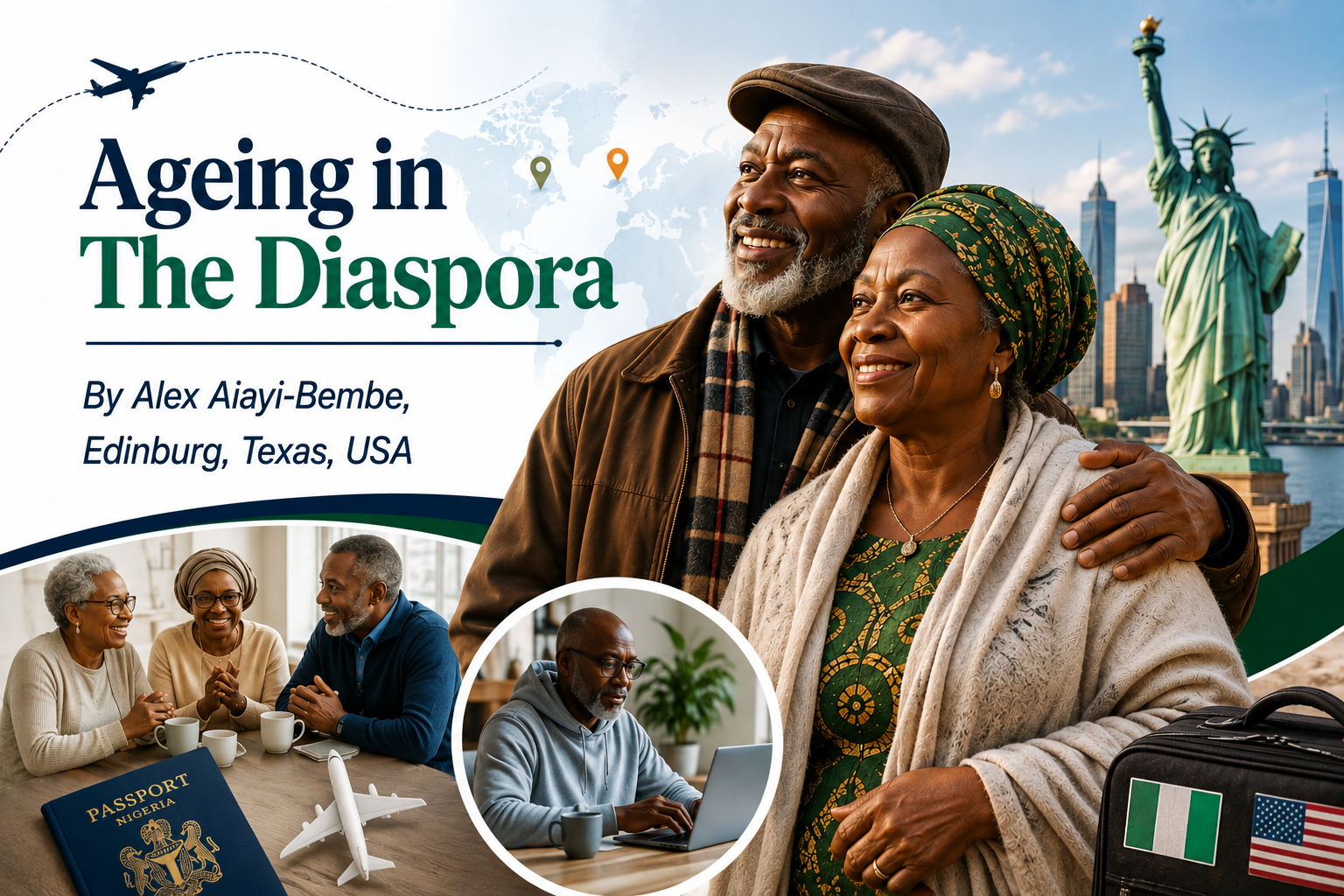

By
Alex Aiayi-Bembe, Edinburg, Texas, USA
For generations, caring for older relatives has been deeply rooted in Nigerian culture. Parents grow old surrounded by their children and grandchildren, while extended family members often share responsibility for their care.
But what happens when Nigerians who migrated abroad decades ago begin to grow old themselves?
Earlier articles examined the support systems available to senior citizens in the United States. This article looks at the growing number of Nigerians ageing in the diaspora and the difficult choices they face as retirement approaches.
From the “Golden Fleece” to Permanent Migration
Migration meant something different to many Nigerians in the years immediately after independence.
During the post-independence era and particularly through the oil boom of the late 1960s to the early 1980s, many Nigerians travelled abroad primarily in search of education and professional advancement.
The United States, United Kingdom, Canada and other European countries became destinations for young Nigerians seeking what was popularly described as the “golden fleece”.
Many eventually returned home with advanced degrees, professional skills and families. They became lecturers, doctors, engineers, civil servants, politicians, entrepreneurs and professionals who contributed to Nigeria’s development.
From the mid-1980s, however, Nigeria’s economic difficulties, political instability and the weakening naira gradually changed the pattern.
For many Nigerians abroad, temporary migration became permanent migration.
Instead of returning after completing their education, they established careers, raised children and built homes and financial security in their adopted countries.
Decades later, some of those same Nigerians are now approaching or entering retirement.
And with retirement comes a new set of questions: Where should I spend my old age? Who will care for me? Where is home? And where can I receive the best healthcare?
Ageing Between Two Worlds
For many Nigerians in the diaspora, social and cultural connections remain important anchors.
Churches, mosques, Nigerian associations, social gatherings and community networks provide opportunities to maintain cultural identity and friendships.
Yet maintaining social connections is not necessarily the same as having a strong support system for old age.
Recreation and rest can also become afterthoughts.
After decades of working, raising children and meeting financial obligations, some older Nigerians find themselves unsure of how to transition from a life structured around work to one centred on wellbeing, leisure and healthy ageing.
Even visits to Nigeria may not provide the rest they need.
A trip home can quickly become a packed schedule of family visits, ceremonies, business meetings, property matters and community obligations.
The holiday becomes another responsibility.
This raises an important question: After decades of work abroad, how should Nigerians approach retirement and ageing?
To Return Home or Stay Abroad?
For Nigerians aged 60 and above, the decision to remain abroad or retire in Nigeria can be complicated.
Returning home may offer familiarity, cultural connection and proximity to relatives. It may also provide an opportunity to reconnect with friends, community and a lifestyle that feels more familiar.
But there are concerns.
Security, healthcare, infrastructure and economic uncertainty can influence the decision.
For those who have spent several decades abroad, Nigeria may still feel like home culturally, while their everyday lives, healthcare arrangements and social networks have become firmly rooted in their adopted countries.
The situation can be particularly complicated for those whose adult children remain abroad.
A Nigerian grandmother, for instance, may spend considerable time travelling between countries to support her children and grandchildren. What may once have been an occasional family visit can become a regular responsibility.
In some cases, grandparents provide childcare for grandchildren while their adult children work.
This can be deeply rewarding, but it can also affect their own retirement plans, health and wellbeing.
The Healthcare Question
Healthcare may ultimately be one of the most important factors in deciding where to age.
Some Nigerians who retire in Nigeria continue to travel abroad periodically for medical reviews, specialist consultations or major treatment.
For those who spent much of their working lives in countries such as the United States, access to established healthcare systems and insurance arrangements can create a strong sense of security.
Medicare and retiree health benefits, where applicable, may also make remaining abroad more practical.
At the same time, familiarity and trust in Western healthcare systems can make some retirees reluctant to completely abandon the systems in which they have received care for decades.
This creates an interesting pattern: a person may choose Nigeria as the place to live in retirement while maintaining strong healthcare connections abroad.
Rethinking Retirement
Perhaps the most important lesson is that retirement should not be treated as a decision to be made only when employment ends.
For Nigerians in the diaspora, planning for healthy ageing may need to begin years before retirement.
Where will they live?
How close will they be to their children?
What healthcare arrangements will they have?
Who will provide support if they become frail?
Can their preferred home accommodate their changing physical needs?
And, importantly, where do they actually feel they belong?
There may be no single answer.
Some Nigerians will choose to remain abroad, where their children, healthcare and financial arrangements are established. Others will return permanently to Nigeria. Some may divide their time between both countries.
The important thing is to plan deliberately rather than allowing circumstances to make the decision.
Ageing Is More Than a Place
Ultimately, healthy ageing in the diaspora is not simply about choosing between Nigeria and another country.
It is about building a life in which older Nigerians can remain connected, financially secure, socially engaged and adequately supported as their needs change.
The Nigerian tradition of caring for older relatives remains valuable, but migration has changed the family structure.
Children may now live thousands of kilometres away. Grandchildren may grow up in countries with different cultures. Healthcare may be spread across two countries. And the meaning of “home” may become increasingly complex.
For Nigerians ageing abroad, therefore, the question may not simply be “Should I return home?”
It may be:
“Where can I grow older with dignity, good health, meaningful relationships and the support I need?”
That is a question worth answering long before retirement arrives.

Ageing in the Diaspora by Alex Aiayi-Bembe is a regular weekly column under our Healthy Ageing Project, a collaborative platform on healthy ageing and longevity, with Healhtimes Communications Nigeria Limited serving as the interim administrative host
