

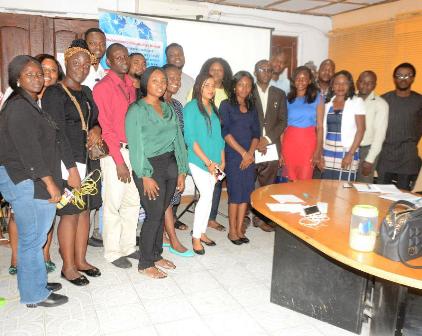
Participabts at the roundtable in a group photograph
An Obstetrics Gynaecologist, Dr Olufunke Olamigoke has called for increased family planning uptake in order to decrease the rate of maternal mortality in Nigeria.
Olamigoke, who spoke on a topic: ‘Family Planning; Cost Effective Strategy in Tackling Maternal Mortality’ at a media round table organized by the Development Communications Network, Devcoms, in Lagos recently, said the lifetime risk of maternal death indicates that one in 30 women in Nigeria will have a death related to pregnancy or child bearing.
The expert who is with Lagos Island Maternity Hospital, identified causes of maternal mortality in Nigeria as obstetrics haemorrhage, hypertensive disorders, unsafe abortion, obstructed labour, postpartum infections anaemia and others.
She said: “An estimated 358,000 women die each year throughout the world from complications of pregnancy and child birth. According to the United Nations Economic Commissions for Africa, the 10 countries with the highest maternal mortality ratio are in Africa and an estimated 14 percent of maternal deaths globally occur in Nigeria.
“This can be prevented through targeted and sustained public health awareness campaigns, female education, increase availability of family planning services and training for health care providers.
“Family planning can indirectly reduce maternal deaths by ensuring a woman’s body has sufficient time to recover before another pregnancy,” she added.
She therefore, charged women of reproductive age to embrace the use of contraception noting that it could at least reduce the share of maternal mortality caused by unsafe abortion by up to 15% in Nigeria.
Also speaking at the forum, Mr. Agunloye Oyebola from BudgIT, a civic organization that applies technology to intersect citizen engagement with institutional improvement, to facilitate societal change, lamented the inadequate allocations to the health sector in Nigeria. He added that this is also a contributing factor to maternal mortality in Nigeria.
Oyebola who spoke on a topic: ‘The Nigerian Population and Maternal Mortality/Maternal Health,’ said despite that in April 2011, African Union countries pledged to set a target of allocating at least 15% of their annual budgets to improve the health sector within their borders Nigeria’s health budget is approximately 4% of the 2018 proposed budget. He lamented that this falls very short of the set-out target.
Linking population and maternal mortality, he said that about 40% of all pregnancies in developing countries are unintended and currently, Nigeria’s fertility rate stands at 5.5% (average of six children per woman). He said this increases the woman’s chances of maternal complications/mortality.
Oyebola however, sees family planning as a means to curbing population increase and maternal mortality.
