-
One patient isolated in Abuja as 44 contacts are placed under surveillance
Nigeria has confirmed an imported case of Ebola Bundibugyo virus disease in the Federal Capital Territory (FCT), following laboratory confirmation of the infection in a woman who recently travelled from Uganda.
The confirmation, announced by the Federal Ministry of Health and Social Welfare and reported by the World Health Organization (WHO) on October 20, makes Nigeria the fifth country to detect the virus since an outbreak of the disease was declared in the Democratic Republic of the Congo (DRC) on May 15, 2026.
According to WHO, the patient developed symptoms on October 7, four days after arriving in Nigeria. She sought medical attention at a private health facility in Abuja on October 11, and laboratory testing confirmed Bundibugyo virus infection on October 20.
She has been placed in isolation and is receiving medical care, while health authorities investigate the likely source of her infection and reconstruct her travel and exposure history.
44 contacts being monitored
Health authorities have so far identified 44 contacts, who are being monitored as investigations continue and efforts are intensified to identify anyone else who may have been exposed.
Infection prevention and control measures are also being strengthened at the private health facility where the patient initially sought care.
The Nigeria Centre for Disease Control and Prevention (NCDC) has activated its incident management system to coordinate the response.
WHO said rapid identification of suspected cases, prompt follow-up of contacts and effective infection prevention and control measures will be critical to preventing further transmission.
WHO and its partners are supporting Nigerian health authorities with case investigation, contact tracing, infection prevention and control, and the provision of essential supplies, including personal protective equipment for health workers.
Why Nigeria is on alert
The development comes as the Ebola disease outbreak in the DRC continues to evolve.
WHO said Kenya has reported nine cases linked to an imported case in recent weeks, prompting a call for countries across the region to maintain a high level of preparedness.
This includes strong disease surveillance, rapid investigation of alerts, safe laboratory testing, readiness of rapid response and clinical teams, strengthened infection prevention and control in both public and private health facilities, pre-positioning of essential supplies and increased monitoring at points of entry.
WHO has advised against restrictions on travel to, or trade with, affected countries, while continuing to monitor developments and travel and trade measures.
What is Bundibugyo virus disease?
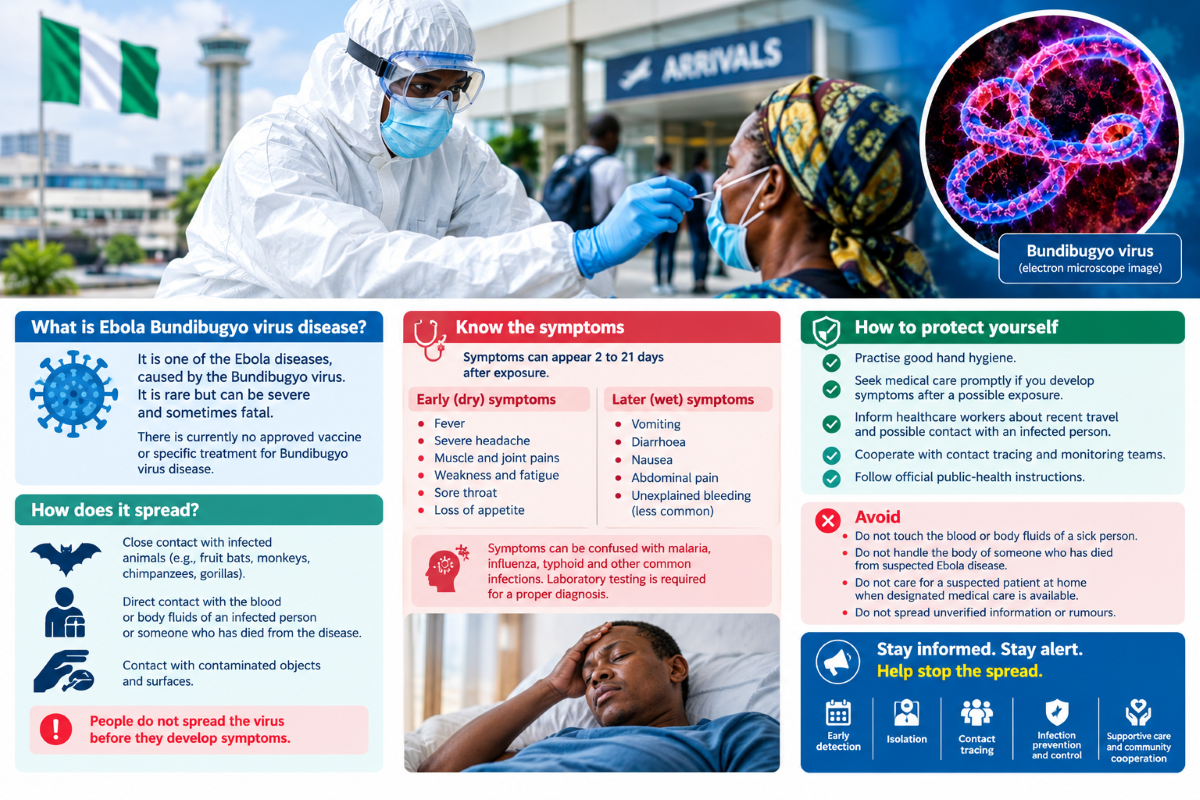
Bundibugyo virus disease is one of three Ebola diseases known to cause large outbreaks. The others are Ebola virus disease, caused by Ebola virus, and Sudan virus disease, caused by Sudan virus.
WHO describes Ebola disease as a rare but severe illness that can be fatal. The average case fatality rate across Ebola disease outbreaks is around 50%, although rates have varied from 25% to 90% in previous outbreaks.
Importantly, the WHO fact file states that while licensed vaccines and therapeutics are available for Ebola virus disease, there is currently no approved vaccine or treatment for Bundibugyo virus disease. Candidate products are under development.
This makes early detection, isolation, supportive care, contact tracing and strict infection prevention particularly important in controlling the disease.
How does Ebola disease spread?
Ebola disease is thought to have animal origins, with fruit bats considered natural hosts of the virus. Human infection can occur following close contact with infected animals, including fruit bats, chimpanzees, gorillas, monkeys and other wildlife.
Human-to-human transmission occurs primarily through direct contact with the blood or other body fluids of a person who is sick with Ebola disease or has died from it.
People can also become infected through contact with objects or surfaces contaminated with body fluids such as blood, faeces or vomit.
A critical point for the public is that people do not transmit Ebola disease before they develop symptoms. They remain infectious while the virus is present in their blood.
Healthcare workers are particularly vulnerable when treating suspected or confirmed patients if appropriate infection prevention and control precautions are not strictly followed.
Traditional burial practices involving direct contact with the body of someone who has died from Ebola can also facilitate transmission.
Know the symptoms
Symptoms can develop 2 to 21 days after exposure, with people typically becoming ill about eight to 10 days after exposure.
Early symptoms are often non-specific and may include fever, muscle and joint aches, severe headache, weakness and fatigue, sore throat and loss of appetite.
Because these symptoms can resemble common illnesses such as malaria, influenza, typhoid fever, meningococcal disease and pneumonia, Ebola disease can be difficult to recognise clinically in its early stages.
As the illness progresses, patients may develop vomiting, diarrhoea, nausea and abdominal pain. Some patients may also experience rash, red eyes, chest pain, difficulty breathing, confusion, hiccups or seizures.
Although Ebola is widely associated with bleeding, WHO notes that bleeding is less frequent than commonly perceived and may occur later in the disease.
What should Nigerians do?
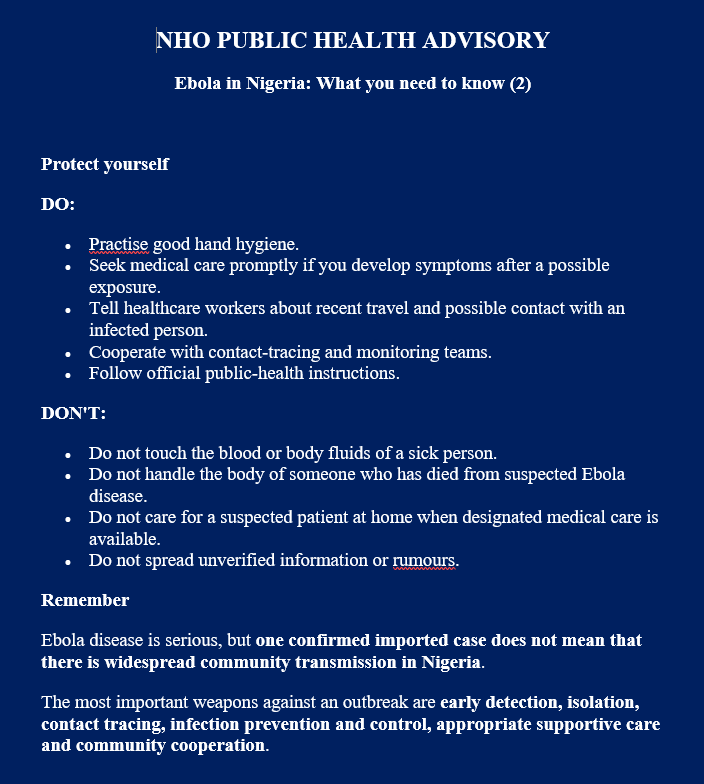
The confirmation of one imported case does not mean that Nigerians should panic.
However, people should take public-health advice seriously, particularly anyone who has recently travelled to an affected area or has had close contact with a suspected or confirmed case.
Anyone who develops a compatible illness after a possible exposure should seek medical attention promptly and disclose their travel and exposure history to healthcare workers.
People should avoid close physical contact with anyone suspected of having Ebola disease and should not handle the blood or other body fluids of a sick person.
WHO recommends that suspected patients be isolated in a designated treatment facility, where they can receive early care while reducing the risk of transmission to household members and others.
Good hand hygiene and a clean environment also remain important.
For communities, accurate information and cooperation with public-health authorities are essential. Contact tracing and monitoring are designed to identify people who may have been exposed early, so that they can receive appropriate follow-up and care.
WHO says contacts should be monitored for 21 days, corresponding to the maximum incubation period of Ebola disease.
Early care can save lives
There is no need to wait for severe symptoms before seeking help after a significant exposure.
WHO says early intensive supportive care—including rehydration and treatment of specific symptoms—can improve survival, making early recognition and care critical.
For now, Nigeria’s response is focused on identifying and monitoring contacts, preventing transmission, protecting healthcare workers and ensuring that any additional cases are detected quickly.
For Nigerians, the message is simple: stay informed, avoid rumours and panic, report compatible symptoms and relevant exposure promptly, and cooperate with health authorities if contacted as a possible contact.