

All that Alhaji Alli, 65, a retired civil servant, wanted after retirement was to settle peacefully in his village, Rogo, a rural community in Rogo Local Government Area of Kano State.
Nearly three years after retiring from one of the Federal Government ministries in Abuja, however, Alli has found that growing older in rural Nigeria comes with challenges he never anticipated.
He is now living with degenerative joint disease affecting virtually all the joints of his body, dizzy spells and poorly controlled diabetes mellitus. The conditions have restricted his movement and turned farming, one of the activities he had hoped to enjoy in retirement, into an almost impossible task.
Alli has also discovered that the health insurance coverage he enjoyed while in service is no longer readily available to him in the same way.
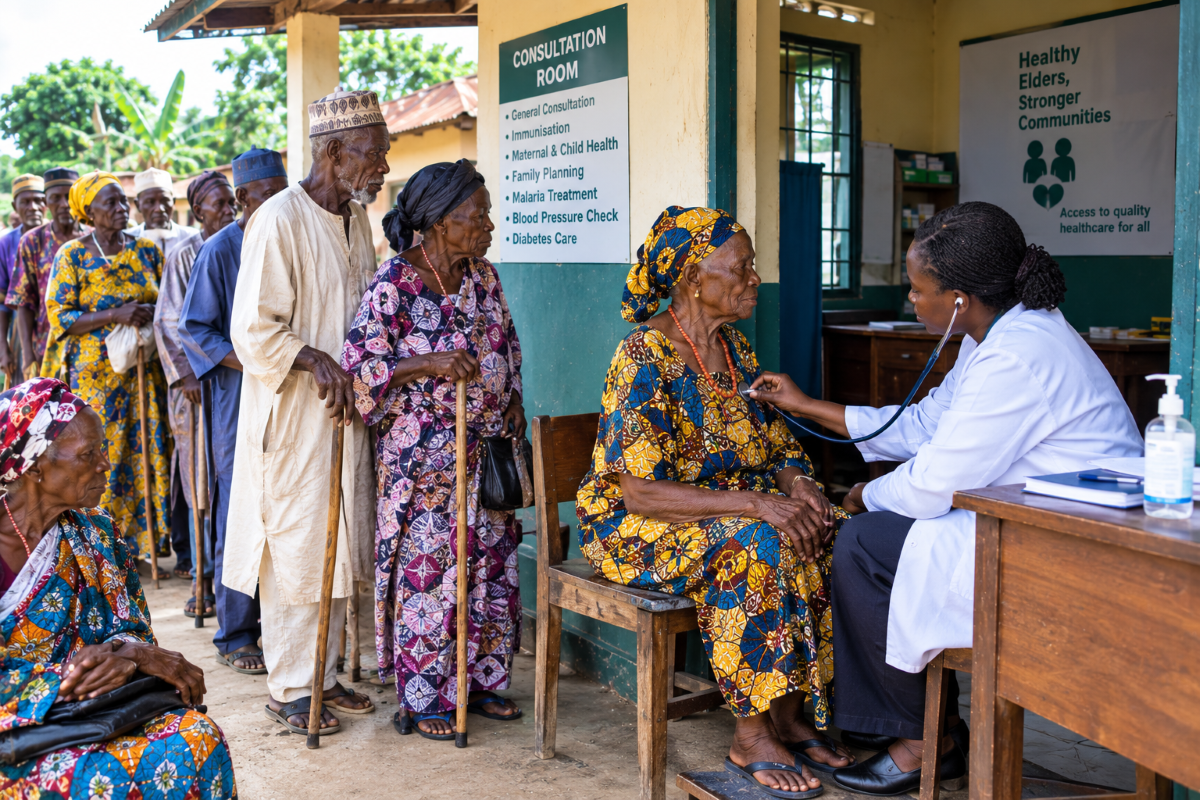
Like other villagers, he must find his way to Rogo General Hospital at Rogo Sabon Gari, some distance from his home, or seek treatment from one of the private clinics around him. Neither option offers the kind of specialised care that an older person with several chronic conditions may require.
At the general hospital, he takes his turn among many other patients waiting to see the few available doctors. If laboratory tests or medicines are prescribed, he may have to spend additional time in queues at the laboratory or pharmacy.
And there is another burden: the rising cost of medicines and other medical services.
Alhaji Alli is not alone
For many older Nigerians, particularly those living in rural communities and those without adequate financial resources, ageing can mean facing a health-care system that is not sufficiently prepared for their needs.
According to a 2024 paper in the Journal of Global Medicine, “Current status and the future trajectory of geriatric services in Nigeria”, Dr Ogugua Osi-Ogbu of the Department of Geriatrics, National Hospital, Abuja, older adults are at greater risk of disease, disability and adverse effects from medicines.
The geriatrician explained that diseases can interact with the effects of ageing to produce complications known as geriatric syndromes.
These include falls, dizziness, fainting, urinary incontinence, weight loss and frailty. Older people may also experience problems associated with mobility, vision and hearing, sleep, memory and cognitive function.
The risk of chronic non-communicable diseases also increases with age. These include hypertension, diabetes, stroke, some cancers and disorders of blood lipids.
Degenerative joint diseases, falls and mobility problems can further reduce an older person’s ability to live independently.
These conditions are sometimes described as the “giants of geriatrics” because of their profound effects on quality of life and functional ability.
Yet many Nigerians approaching or already in old age may have little understanding of the health complications associated with ageing. More importantly, many do not have the financial resources or access to appropriate services to manage them when they occur.
For a large proportion of older Nigerians, the cost of health care remains a major barrier.
Medicines, diagnostic tests, consultations and hospital treatment can consume a substantial part of household income, while many older people have limited or no regular income after retirement.
The problem is particularly serious for those who depend largely on out-of-pocket payments.
Too few specialists
Nigeria also faces a shortage of doctors specially trained to care for older people.
Geriatric medicine requires more than treating individual diseases. Older patients often have several conditions at the same time and may be taking multiple medicines. They may also require rehabilitation, nutritional support, assistance with mobility, mental-health care and help with activities of daily living.
Yet specialist geriatric services remain limited and are concentrated largely in a small number of tertiary health institutions.
The University College Hospital, Ibadan, for example, is home to the Tony Anenih Geriatric Centre, while other tertiary institutions, including the National Hospital, Abuja and the University of Benin Teaching Hospital, have developed services for older people.
But access to such specialised services remains a major challenge for people who live far from these centres.
The situation is even more difficult in rural communities.
Older people in rural Nigeria may have to contend with long distances to health facilities, poor roads, inadequate public transportation and limited availability of doctors and medicines.
They may also depend heavily on family members for transport, money and daily care.
Dr Osi-Ogbu noted that the challenge is particularly acute in northern Nigeria, where older patients may travel long distances to access specialist geriatric care.
At the National Hospital, Abuja, he said, the geriatrics unit receives older patients ranging in age from 60 to 102 years from different parts of the country.
Many of these patients, he noted, are cared for by paid caregivers because their younger relatives have moved to urban areas in search of work.
Where such caregivers lack adequate training, the older person may remain vulnerable despite being physically close to someone providing care.
Some hope, but more is needed
It is not all gloom.
Nigeria has taken steps towards strengthening the welfare and social protection of older citizens. The National Senior Citizens Centre (NSCC), established by law, is the Federal Government’s focal institution for issues affecting senior citizens.
There have also been efforts at federal and state levels to expand social protection, health insurance, screening, rehabilitation and other services for older people.
The National Health Insurance Authority (NHIA) Act also provides a framework for expanding health coverage and includes mechanisms intended to support vulnerable groups.
Some states have introduced or expanded health insurance and social-support programmes that include pensioners and older residents.
These are important developments.
However, the existence of policies and programmes does not automatically translate into access to care for an elderly person living in a remote village.
For people like Alhaji Alli, what matters is whether there is an affordable health facility within reasonable distance; whether a trained health worker is available; whether essential medicines and diagnostic services can be obtained; whether chronic diseases can be monitored regularly; and whether referral and transport arrangements exist when specialised treatment is required.
Nigeria’s ageing population makes these questions increasingly urgent.
The country cannot continue to approach ageing largely as a family responsibility while leaving families themselves increasingly stretched by poverty, migration and other social pressures.
Older Nigerians need a health-care system that recognises the realities of ageing and responds to them.
For Alhaji Alli and millions of other older Nigerians, therefore, the real challenge is not simply growing old but growing old without reliable access to affordable, appropriate and age-friendly health care.
As Nigeria’s older population grows, the country must move beyond policies and promising initiatives to ensure that geriatric services, health insurance, essential medicines, rehabilitation and trained caregivers reach older people wherever they live—including the villages and rural communities where many spend their later years.
Growing old should not become a health-care disadvantage.
- The Healthy Ageing Project is a collaborative platform on healthy ageing and longevity, with Healhtimes Communications Nigeria Limited serving as the interim administrative host.
