

By
 Pharm. Gbenga Oyinloye
Something interesting is happening among young Nigerians. Mental health is being discussed more openly than it was by previous generations. Conversations about anxiety, burnout, depression, therapy and emotional wellbeing are increasingly visible on X, Instagram, TikTok and WhatsApp. More young people are willing to say, “I am not okay.”
But there is a problem: talking about mental health has become easier than accessing mental health support.
For many young Nigerians, the journey from “I think something is wrong” to “I know where to get help, I can afford it, I feel safe asking for it and someone will actually help me” remains far too long.
That is where many interventions miss the mark.
- Awareness is not enough
Mental health programmes often begin with awareness. Posters are designed. Seminars are organised. Hashtags trend for a few days. Someone speaks about the importance of seeking help.
All of that has value.
But awareness alone does not solve a broken pathway to care.
A young person may know that depression is real and still not know whom to call. They may understand that therapy can help and still be unable to afford it. They may want help but worry that their parents, friends, religious community or colleagues will judge them.
Nigeria’s mental health challenges are shaped by numerous social pressures, including poverty, academic stress, unemployment, family difficulties, violence, bullying and stigma. At the same time, access to mental health professionals remains limited and unevenly distributed.
So the question should not simply be: How do we teach young Nigerians more about mental health?
It should be: What would make it easier for a young Nigerian to actually receive the right support when they need it?
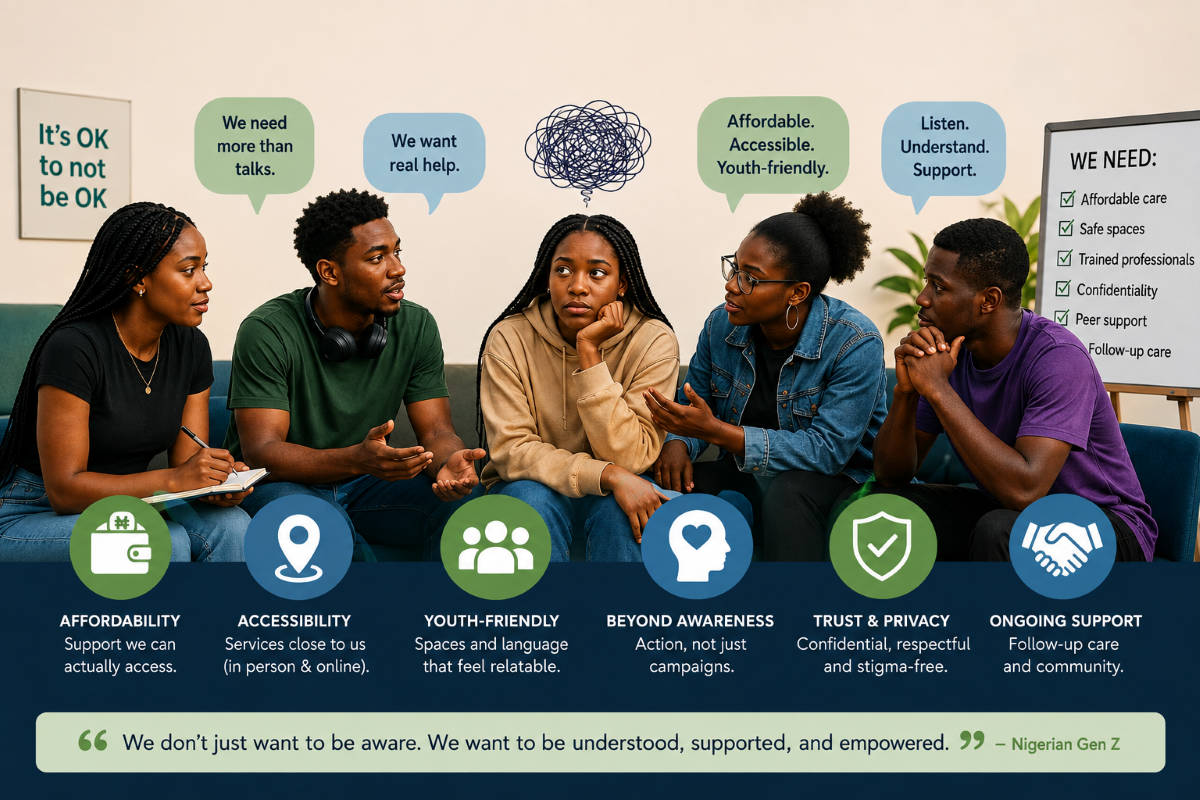
- They want support that is accessible
For a generation accustomed to doing almost everything through a phone, navigating a complicated healthcare system can feel like another barrier.
Young people need clear entry points. These could include confidential digital services, youth-friendly primary healthcare, trained counsellors in schools and universities, community-based support and professionals who can provide appropriate referrals when specialist care is needed.
It also means meeting young people where they already are.
Mental health support cannot exist only inside psychiatric hospitals and specialist clinics. A young person might first mention their distress to a friend, pharmacist, doctor, lecturer, religious leader or youth worker.
These points of contact can become opportunities for early identification and appropriate referral, provided the people involved are properly trained and understand the limits of their roles.
- They want to be listened to, not lectured
Perhaps one of the biggest mistakes in mental health programming is assuming that young people need another lecture.
They don’t.
They need spaces where they can speak without immediately being labelled lazy, unserious, spiritually weak, dramatic or attention-seeking.
This does not mean abandoning professional care or pretending that every mental health problem can be solved through friendship. It means recognising that dignity and respect are part of care.
Young people should also have a voice in designing the services intended for them, rather than simply being invited to attend programmes designed by others.
If an intervention does not reflect how young people actually live, communicate and seek help, even a well-funded programme can struggle to reach the people it was designed to serve.
- They want help that understands Nigerian reality
It is difficult to tell a young Nigerian experiencing financial pressure to “just practise self-care” without acknowledging the environment around them.
Rent is rising. Finding decent employment can be difficult. Students worry about academic performance and their future. Young workers worry about job security. Social media constantly provides opportunities to compare our lives with people who appear to be doing better.
Sometimes the source of distress is not an abstract psychological problem. It is unemployment, family pressure, loneliness, academic failure, grief, relationship difficulties or uncertainty about the future.
Mental health interventions therefore need to understand the social conditions in which young Nigerians live.
Support cannot simply import solutions developed for completely different environments and expect them to work unchanged.
- They want affordability and confidentiality
For many young Nigerians, the question is not whether therapy would help.
The question is: “Can I afford it?”
If mental health support remains financially inaccessible, awareness campaigns can create an uncomfortable situation in which people become more aware of their struggles without becoming more capable of addressing them.
Nigeria needs stronger integration of mental health into primary healthcare, community services, schools and other existing systems. We also need greater investment in prevention and early intervention, rather than waiting until problems become severe before help becomes available.
Then there is confidentiality.
A young person may hesitate to seek help because they fear that their information could reach their parents, classmates, employer, church, mosque or wider community.
Confidentiality cannot simply be promised. It has to be built into how services operate.
Young people need to know who will have access to their information, what happens after they disclose a concern, and when information may need to be shared for safety reasons.
Trust is not an optional extra in mental healthcare. It is the foundation.
- Perhaps we should simply ask Gen Z
Perhaps the biggest change is also the simplest: ask young people what they need.
We spend enormous amounts of time designing interventions for young people. Perhaps we should spend more time designing them with young people.
Before launching another mental health campaign, ask:
What stops you from seeking help?
Who would you trust?
What would make you feel safe?
What could you realistically afford?
Would you prefer online or face-to-face support?
What would make you return after your first contact?
What would make you recommend the service to a friend?
Those questions could reveal more than another awareness poster.
Nigeria does not lack young people willing to talk about mental health. The challenge is turning that growing openness into accessible, affordable, confidential and trustworthy care.
Gen Z is not asking for a perfect mental health system.
They are asking for one that understands the reality they live in.
And perhaps that is where we should begin.
Gbenga Oyinloye is a pharmacist with a strong interest in mental health advocacy, youth wellbeing and improving access to psychological support. He is passionate about creating conversations that reduce stigma and promote more compassionate approaches to mental healthcare.
