
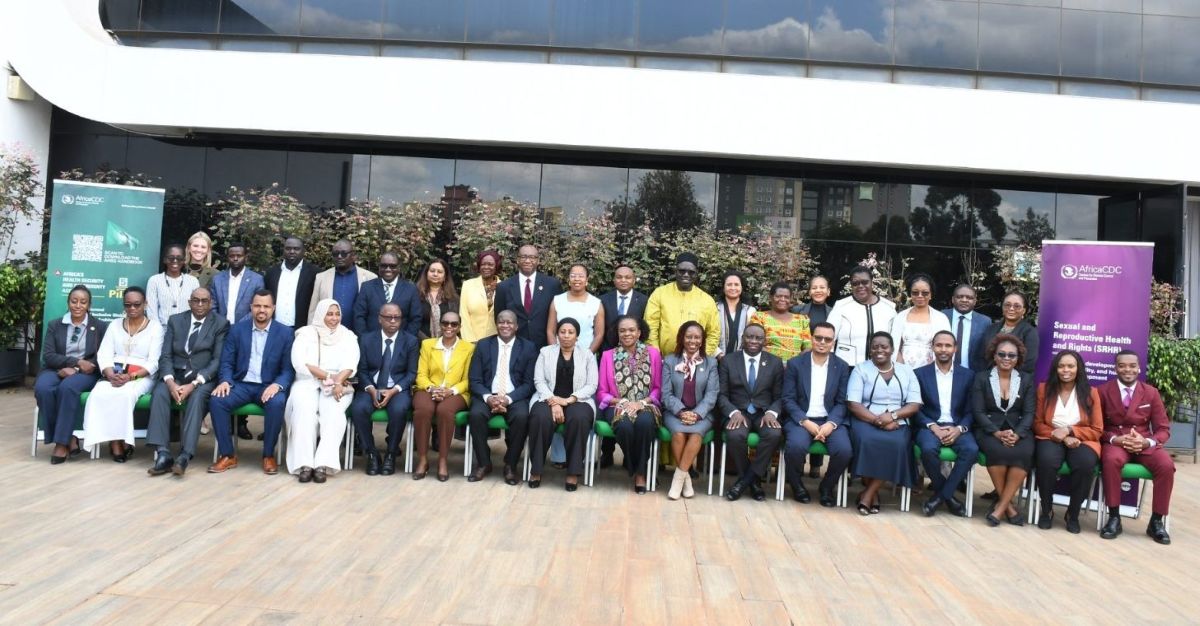

Africa Centres for Disease Control and Prevention (Africa CDC), in collaboration with the African Union Commission, Member States and development partners, has reinforced its campaign to end preventable maternal, newborn and child deaths across the continent following a three-day regional policy validation workshop held in Nairobi, Kenya.
The workshop, held from 8 to 10 July 2026, brought together representatives from 23 African Union Member States, regional institutions, technical experts and development partners to validate findings from a continent-wide assessment of Sexual, Reproductive, Maternal, Newborn, Child and Adolescent Health (SRMNCAH) policies, financing, governance, service delivery and accountability.
The meeting forms part of Africa CDC’s Health Security and Sovereignty Agenda and supports the African Union Champion for Maternal and Child Health initiative led by Tanzanian President Dr Samia Suluhu Hassan, which seeks to place maternal, newborn and child survival at the heart of Africa’s health and development agenda.
Delivering opening remarks on behalf of H.E. Dr Jean Kaseya, Director General of Africa CDC, Dr Lul Pout Riek, Special Representative of the Director General for the Eastern Africa Regional Coordinating Centre, said maternal and child survival must remain a continental leadership priority.
“Africa’s health security is measured in the lives of women, newborns, children and adolescents. Every preventable death reflects a gap in governance, financing, equity, access and accountability,” Dr Lul said.
He called on Member States and partners to use the workshop as a platform for implementation and measurable progress.
“Let this workshop be remembered as the moment where we chose implementation over intention, partnership over fragmentation, and action over aspiration. History will remember the lives we saved,” he said.
Representing H.E. Dr Samia Suluhu Hassan, Hon. Ummy Mwalimu, Head of Secretariat and Advisor to the President, reaffirmed the AU Champion’s commitment to mobilising political leadership across the continent.
She said the Champion’s roadmap is aligned with Agenda 2063, the Africa Health Strategy, Africa CDC’s Health Security and Sovereignty Agenda, and other continental commitments. The roadmap advances three measurable goals: zero maternal deaths, zero preventable newborn deaths and zero unvaccinated children.
“The challenge before us is no longer identifying solutions. Africa knows what works. Our responsibility now is to implement those solutions at scale, strengthen accountability and ensure sustainable financing,” Hon. Mwalimu said.
Providing the technical framing for the workshop, Dr Diana Nambatya Nsubuga, Head of Division for Reproductive, Maternal, Newborn, Child and Adolescent Health at Africa CDC, said Africa is navigating a rapidly changing health financing landscape marked by declining external assistance, increasing debt burdens, climate-related shocks and continued dependence on imported health commodities.
“The change we need is moving from dependency to ownership, from vulnerability to resilience, and from aspiration to action,” Dr Nambatya Nsubuga said.
She outlined five strategic priorities for achieving the AU Champion’s vision: stronger primary health care, predictable domestic financing, accelerated digital transformation, expanded local manufacturing of health commodities and medicines, and a reformed global health architecture led by Africa.
Dr Nambatya Nsubuga also announced that 50 of 55 African Union Member States, representing 91 percent, have completed the continental SRMNCAH policy assessment. Africa CDC is following up with the remaining five Member States to ensure full continental representation.
The assessment will culminate in the first comprehensive continental report examining the policy, financing and health system drivers of maternal, newborn and child health outcomes across Africa.
The Ministry of Health of Kenya welcomed delegates and reaffirmed Kenya’s commitment to strengthening maternal, newborn, child and adolescent health through investments in primary health care, emergency obstetric services, community health systems, health infrastructure, digital health and stronger accountability mechanisms.
Representatives from the African Union Commission, East, Central and Southern Africa Health Community (ECSA-HC), the World Health Organization, UNICEF, UNFPA, PMNCH and Pathfinder commended Africa CDC for leading a continent-wide evidence generation process that will support national policymaking, strengthen accountability and accelerate progress towards ending preventable maternal and child deaths.
During the three-day workshop, participants analysed country findings, validated evidence, identified policy and financing gaps, exchanged good practices and agreed on priority actions to strengthen implementation of high-impact maternal and child health interventions across Member States
The validated assessment is expected to inform evidence-based policymaking, strengthen domestic resource mobilisation and improve accountability while advancing the African Union Champion’s vision of zero maternal deaths, zero preventable newborn deaths and zero unvaccinated children. It will also contribute to the first comprehensive continental report examining the policy, financing and health system drivers of maternal, newborn and child health outcomes across Africa.
The Africa CDC initiative comes at a time when many African countries, including Nigeria, are seeking to reduce maternal and newborn deaths through stronger primary healthcare, improved financing and greater access to quality reproductive and child health services.
