
Japanese researcher wins 2016 Nobel prize for medicine
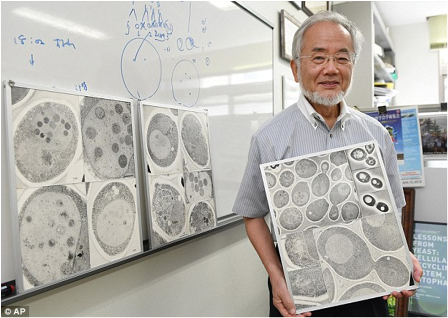
• Professor Ohsumi
Japanese biologist Yoshinori Ohsumi has been declared winner of the 2016 Nobel Prize in medicine.
According to the announcement by the Nobel Assembly at Stockholm’s Karolinska Institute, the biologist was awarded the prize for his work on autophagy.
Professor Ohsumi, a researcher at the Tokyo Institute of Technology, is the sixth Nobel laureate from Japan to win the accolade in the field of medicine.
The Nobel announcement on Ohsumi’s work reads:
The word autophagy originates from the Greek words auto-, meaning “self”, and phagein, meaning “to eat”. Thus,autophagy denotes “self eating”. This concept emerged during the 1960’s, when researchers first observed that the cell could destroy its own contents by enclosing it in membranes, forming sack-like vesicles that were transported to a recycling compartment, called the lysosome, for degradation. “
“Difficulties in studying the phenomenon meant that little was known until, in a series of brilliant experiments in the early 1990’s, Yoshinori Ohsumi used baker’s yeast to identify genes essential for autophagy. He then went on to elucidate the underlying mechanisms for autophagy in yeast and showed that similar sophisticated machinery is used in our cells.
“Ohsumi’s discoveries led to a new paradigm in our understanding of how the cell recycles its content. His discoveries opened the path to understanding the fundamental importance of autophagy in many physiological processes, such as in the adaptation to starvation or response to infection. Mutations in autophagy genes can cause disease, and the autophagic process is involved in several conditions including cancer and neurological disease.”
Born in 1945 in Fukuoka, Yoshinori Ohsumi trained as a cell biologistat at Tokyo University before undertaking research at New York’s prestigious Rockefeller University.
Since setting up his own lab in 1988, his research has focused on the mechanisms of autophagy, by which cells eat their own contents, breaking down components into their building blocks for use elsewhere.
Professor Ohsumi looked at mutants of bakers yeast, identifying the genes which drive this cellular recycling process.
Through his work, scientists now have a clearer understanding autophagy plays in a cell’s lifecycle, including the potentially harmful consequences when it goes wrong.
About author

You might also like
Nigeria targets higher contraceptive prevalence rate
The Federal Government has assured it would lift the nation’s contraceptive prevalence rate, CPR (for family planning) from its present 10 percent to 36 percent in 2018. Director of Child

Pharma company recommends Free Malaria Management programme as part of fuel subsidy palliative
As Nigeria joins the rest of the world to mark the World Malaria Day today, a leading pharmaceutical company, St. Racheal’s Pharma, has called on the in-coming administration led by


Agboyi Ketu: Where TBAs hold all aces as midwives
For the people of Agboyi Ketu, a Lagos suburb, lack of basic amenities and depth of traditional beliefs, strengthen the people’s confidence in Traditional Birth Attendants. NHO correspondent, JULIET UMEH visited the


0 Comments
No Comments Yet!
You can be first to comment this post!