


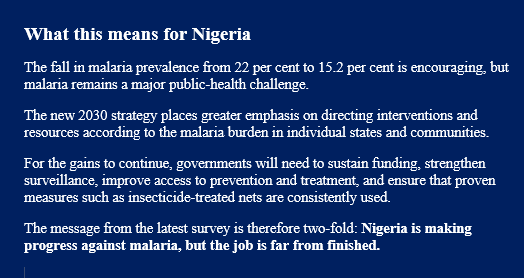
Nigeria has recorded a significant decline in malaria parasite prevalence among children aged 6–59 months, with the rate falling from 22 per cent in 2021 to 15.2 per cent in 2025.
The Federal Government, however, says the improvement is not a reason to relax efforts, setting a target of reducing malaria prevalence and malaria-attributable deaths by 50 per cent from their 2025 levels by 2030.
The Coordinating Minister of Health and Social Welfare, Prof. Muhammad Ali Pate, disclosed this in Abuja at the launch of the 2025 Nigeria Malaria Indicator Survey (NMIS) Report and the National Malaria Strategic Plan 2026–2030.
The Minister, who was represented by the Permanent Secretary of the ministry, Ms Daju Kachollom, described the reduction as meaningful progress in the country’s malaria response.
The 6.8 percentage-point decline in prevalence represents a substantial improvement compared with the 2021 survey, but the government acknowledged that the country remains far from eliminating the disease.
“Progress must not be mistaken for elimination,” the Minister cautioned, pointing to the continuing need for sustained and targeted interventions.
Wide differences across states
The survey also highlights the importance of tailoring malaria interventions to the circumstances of individual states and communities.
Kebbi State, for example, recorded a particularly sharp decline, with malaria prevalence among children aged 6–59 months falling from 49 per cent in 2021 to 18 per cent in 2025.
The Federal Government said such variations underline the need to concentrate resources and interventions in areas where the malaria burden remains highest.
This approach is incorporated into the National Malaria Strategic Plan 2026–2030, which adopts a “Sub-National Tailoring” strategy to guide malaria interventions according to local epidemiological evidence.
The plan is aligned with the Nigeria Health Sector Renewal Investment Initiative (NHSRII) and will be implemented through the Sector-Wide Approach (SWAp), built around the principle of “One Plan, One Budget, One Report, One Conversation.”
Insecticide-treated nets
The survey also provides an indication of the use of insecticide-treated nets, one of the major tools for preventing malaria transmission.
Among households that owned insecticide-treated nets, 72.3 per cent of children and 80.6 per cent of pregnant women slept under one.
While the figures indicate substantial use, the government said there is still a need to improve consistent utilisation of the nets.
This is particularly important because children under five and pregnant women remain among the groups most vulnerable to severe malaria and its complications.
Evidence to guide investment
The Director-General of the National Population Commission, Dr Abuh Muhammed, said the NMIS demonstrated the value of collaboration between the National Malaria Elimination Programme and the Commission.
According to him, the partnership brought together technical expertise in malaria control and the Commission’s survey infrastructure and field operations.
He reaffirmed the Commission’s commitment to supporting evidence-based planning and urged policymakers and development partners to use the survey findings to direct resources to areas where they are most needed.
The Federal Government also called on state governments to take ownership of their individual NMIS findings by aligning malaria plans and budgets with identified needs and ensuring the timely release of funds.
Development partners were similarly urged to align their investments and technical support with national malaria priorities.
The road to 2030
The government said achieving the 2030 target will require sustained domestic financing, stronger surveillance and a coordinated national response.
The target is particularly significant for Nigeria, which continues to carry a large share of the global malaria burden.
The latest survey shows that progress is possible, but also demonstrates why a one-size-fits-all approach may not be sufficient. States and communities with different levels of transmission will require interventions that reflect their specific circumstances.
The challenge now is to ensure that the reduction recorded between 2021 and 2025 is sustained and accelerated rather than reversed.
For millions of Nigerians, particularly children and pregnant women, achieving the 2030 target could translate into fewer malaria infections, fewer severe cases and fewer preventable deaths.
