


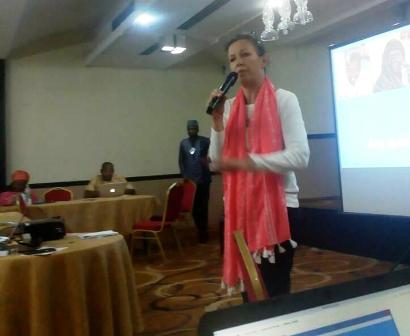
OCHA Head of communication, Samantha Newport, during her presentation
Humanitarian interventions in reconstructing the devastations in North East Nigeria will require at least $1bn in 2018 to address. The fund is needed to meet some of the needs of about 6.1 million people of 7.7 million in dire need of humanitarian response in the region.
This was disclosed recently by the United Nations Office for the Coordination of Humanitarian Affairs (UNOCHA, Nigeria) in a two day dialogue with the media in Kano State with the theme: “The Humanitarian Crisis in the North-East: Taking Stock and Looking Ahead.”
Head of Communications OCHA Samantha Newport, in her presentation, noted that that humanitarian crisis in North East Nigeria remains severe, nine years after, due to ongoing conflict, continued internal displacement and the unpredictable return of refugees from neighbouring countries.
She said the humanitarian crisis in North East remains one of the most severe in the world. “Hence, in 2016, the Government of Nigeria asked for international support; and by 2017, 14 million people in the North East had needed life-saving assistance in Borno, Adamawa, Yobe, Bauchi, Taraba and Gombe”, Newport said.
The programme was put together by the UN Systems which includes- the World Health Organisation (WHO), United Nations Population Fund (UNFPA), United Nations Children’s Fund (UNICEF), United Nations Office for the Coordination of Humanitarian Affairs (OCHA), United Nations High Commission for Refugees (UNHCR) and International NGOs (INGO forum) to provide updates on roles each is playing in assisting Nigeria rebuild the North East.
In his presentation, Jubril Shittu, International NGOs (INGO forum) said; “continued insecurity prevents us from reaching 900,000 people. We do not have access to them. The situation keeps changing, people keep moving and it’s difficult to plan ahead.
“Also, renewed attacks on returnees in parts of Borno and Yobe States may affect full realisation of recovery and reconstruction unless optimal attention is given by Federal Government to secure the region,” said Shittu.
According to Jorge Martinez, Health Sector Coordinator, MoH/WHO, the health life threatening situation of the displaced persons in the North East needs urgent and optimal support.
“More than 50 percent of the health facilities in the NE are still damaged or non-functional.
“There is a very strong need to strengthen Surveillance in the health sector response especially in Trauma and Primary Healthcare, severe and acute malnutrition (SAM), epidemic prone diseases such as Polio, malaria, measles, acute water diarrhoea among others,” Martinez said.
The Health sector coordinator disclosed that the WHO would need $109.5 million in funding in 2018 to meet the health requirements of 5,123,196 displaced persons out of the 7,884,933 million who actually need help.
Commenting on the programme, Hanson Tamful, external Relation Officer, United Nations High Commissioner for Refugees in Nigeria said the media dialogue aimed to better educate journalists on the humanitarian situation and responses in the North East. He added that reporting in NE by the Nigerian media has not been unanimous and so the media dialogue would create the platform to get a lot of information clear for accurate reportage.
In his presentation, Abdullah Umar of the UN Refugee Agency (UNHCR) noted that though the agency’s mandate handles immediate emergency, in principle, it doesn’t discriminate, pick sides in conflict, don’t get involved in politics and it is independent.
Habib Kori, UNFPA Media Specialist, was worried over how her agency would realise maximum needs to protect the dignity of women in IDP camps from environmental violence.
“Gender Based Violence in IDPs affects all women and girls and issue of protection is mostly the prerogative of government which cannot be compromised at all,” said Kori.